
15 KiB
//[doc-seo]
{
    "Description": "Explore the Identity Server Module (Pro) for ABP Framework, enabling easy management of clients, identity resources, and API resources."
}
Identity Server Module (Pro)
You must have an ABP Team or a higher license to use this module.
This module provides integration and management functionality for Identity Server;
- Built on the IdentityServer4 library.
- Manage Clients, Identity resources and API resources in the system.
- Set permissions for clients.
- Create standard identity resources (like role, profile) easily.
- Create custom identity resources.
- Manage API resources.
- Manage API scopes.
Legacy module: Current ABP startup templates use the OpenIddict module. This IdentityServer4 administration module remains available for existing applications that still use the open-source IdentityServer integration, but it is not installed in newly generated applications.
See the module description page for an overview of the module features.
How to Install
This module was pre-installed in startup templates before ABP v6.0. Current templates use OpenIddict. Install this module only in an application that uses IdentityServer4, and don't install the IdentityServer and OpenIddict provider modules together.
Packages
This module follows the module development best practices guide and consists of several NuGet and NPM packages. See the guide if you want to understand the packages and relations between them.
You can visit the Identity Server module package list to see the related packages.
User Interface
Menu Items
Identity Server module adds the following items to the "Main" menu, under the "Administration" menu item:
- Clients: Client management page.
- Identity resources: Identity resource management page.
- API resources: API resource management page.
- API scopes: API scope management page.
AbpIdentityServerMenuNames class has the constants for the menu item names.
Pages
Client Management
Clients page is used to manage Identity Server clients. A client represent applications that can request tokens from your Identity Server.

You can create new clients or edit existing clients in this page:
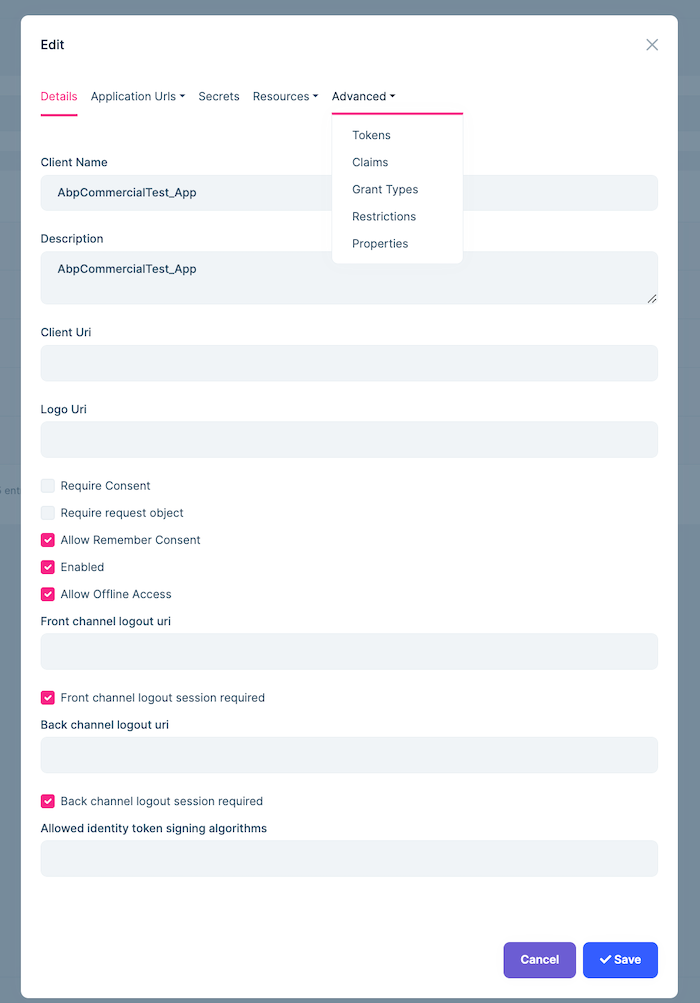
New client secrets submitted during create or update are SHA-256 hashed before they are stored. Configure the consuming client with the original secret value, not the stored hash, and retain the original value in your secret-management system because it cannot be recovered from the hash.
Identity Resource Management
Identity resource page is used to manage identity resources of Identity Server. Identity resources are data like user ID, name, or email address of a user.

You can create a new identity resource or edit an existing identity resource in this page:

This page allows creating standard identity resources (role, profile, phone, openid, email and address) using "Create standard resources" button.
API Resource Management
Identity Server module allows to manage API resources. To allow clients to request access tokens for APIs, you need to define API resources.
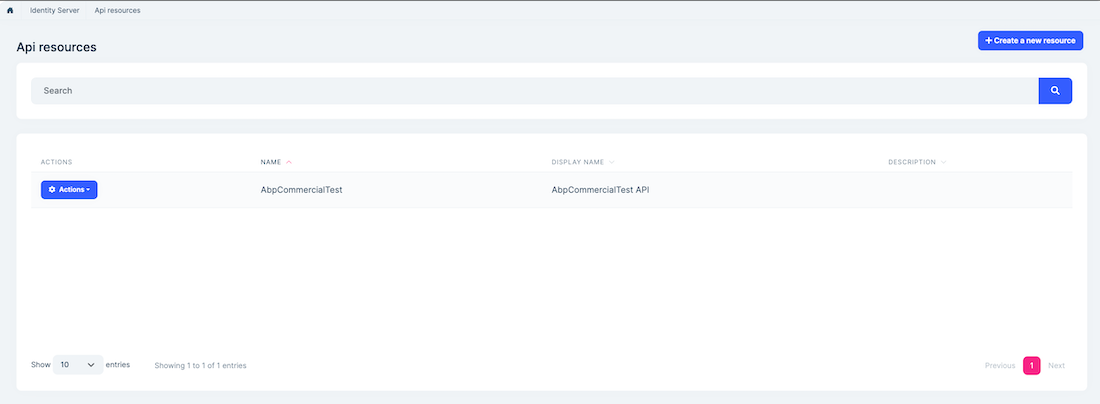
You can create a new API resource or edit an existing API resource in this page:
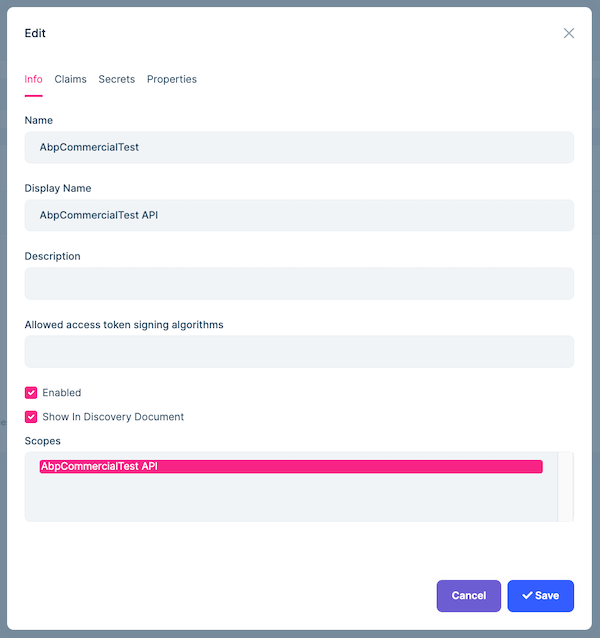
New API resource secrets submitted during update are also SHA-256 hashed before persistence. The consumer must use the original secret value.
API Scope Management
API scopes define the scopes that clients can request. The API scopes page allows you to create, update and delete scopes independently from API resources.
Data Seed
The domain package provides IIdentityResourceDataSeeder, which a legacy application can call from its IdentityServer data seed contributor when the .DbMigrator application runs (see the data seed system):
- Creates standard identity resources which are role, profile, phone, openid, email and address.
You can delete or edit created standard identity resources in the identity resource management page. You can also re-create standard identity resources in the identity resource management page using "Create standard resources" button.
Options
AbpIdentityServerBuilderOptions
AbpIdentityServerBuilderOptions can be configured in PreConfigureServices method of your Identity Server module. Example:
public override void PreConfigureServices(ServiceConfigurationContext context)
{
	PreConfigure<AbpIdentityServerBuilderOptions>(builder =>
	{
    	//Set options here...
	});
}
AbpIdentityServerBuilderOptions properties:
UpdateJwtSecurityTokenHandlerDefaultInboundClaimTypeMap(default: true): UpdatesJwtSecurityTokenHandler.DefaultInboundClaimTypeMapto be compatible with Identity Server claims.UpdateAbpClaimTypes(default: true): UpdatesAbpClaimTypesto be compatible with identity server claims.IntegrateToAspNetIdentity(default: true): Integrate to ASP.NET Identity.AddDeveloperSigningCredential(default: true): Set false to suppress AddDeveloperSigningCredential() call on the IIdentityServerBuilder.AddIdentityServerCookieAuthentication(default: true): Adds IdentityServer's default cookie authentication handlers. Set it tofalsewhen the host registers and configures these handlers itself.
IIdentityServerBuilder can be configured in PreConfigureServices method of your Identity Server module. Example:
public override void PreConfigureServices(ServiceConfigurationContext context)
{
	PreConfigure<IIdentityServerBuilder>(builder =>
	{
    	builder.AddSigningCredential(...);
	});
}
Internals
Domain Layer
Aggregates
This module follows the Entity Best Practices & Conventions guide.
ApiResource
API Resources are needed for allowing clients to request access tokens.
ApiResource(aggregate root): Represents an API resource in the system.ApiResourceSecret(collection): secrets of the API resource.ApiResourceScope(collection): scope names associated with the API resource.ApiResourceClaim(collection): claims of the API resource.
ApiScope
ApiScope(aggregate root): Represents an API scope.ApiScopeClaim(collection): Claims included for the scope.ApiScopeProperty(collection): Custom properties of the scope.
Client
Clients represent applications that can request tokens from your Identity Server.
Client(aggregate root): Represents an Identity Server client application.ClientScope(collection): Scopes of the client.ClientSecret(collection): Secrets of the client.ClientGrantType(collection): Grant types of the client.ClientCorsOrigin(collection): CORS origins of the client.ClientRedirectUri(collection): redirect URIs of the client.ClientPostLogoutRedirectUri(collection): Logout redirect URIs of the client.ClientIdPRestriction(collection): Provider restrictions of the client.ClientClaim(collection): Claims of the client.ClientProperty(collection): Custom properties of the client.
PersistedGrant
Persisted Grants stores AuthorizationCodes, RefreshTokens and UserConsent.
PersistedGrant(aggregate root): Represents PersistedGrant for identity server.
DeviceFlowCodes
DeviceFlowCodes(aggregate root): Stores device authorization data until it expires.
IdentityResource
Identity resources are data like user ID, name, or email address of a user.
IdentityResource(aggregate root): Represents an Identity Server identity resource.IdentityResourceClaim(collection): Claims of the identity resource.
Repositories
This module follows the Repository Best Practices & Conventions guide.
Following custom repositories are defined for this module:
IApiResourceRepositoryIApiScopeRepositoryIClientRepositoryIDeviceFlowCodesRepositoryIPersistentGrantRepositoryIIdentityResourceRepository
Domain Services
This module follows the Domain Services Best Practices & Conventions guide.
Identity Server module doesn't contain any domain service but overrides services below;
AbpProfileService(Used whenAbpIdentityServerBuilderOptions.IntegrateToAspNetIdentityis true)AbpClaimsServiceAbpCorsPolicyService
Settings
This module doesn't define any settings.
Application Layer
Application Services
ClientAppService(implementsIClientAppService): Implements client management and client permission operations.IdentityServerClaimTypeAppService(implementsIIdentityServerClaimTypeAppService): Gets the available claim types.ApiResourceAppService(implementsIApiResourceAppService): Implements API resource management.ApiScopeAppService(implementsIApiScopeAppService): Implements API scope management.IdentityResourceAppService(implementsIIdentityResourceAppService): Implements the use cases of the Identity resource management UI.
Database Providers
Common
Table/Collection Prefix & Schema
All tables/collections use the IdentityServer prefix by default. Set static properties on the AbpIdentityServerDbProperties class if you need to change the table prefix or set a schema name (if supported by your database provider).
Connection String
This module uses AbpIdentityServer for the connection string name. If you don't define a connection string with this name, it fallbacks to the Default connection string.
See the connection strings documentation for details.
IdentityServer configuration is host data. The built-in EF Core and MongoDB contexts ignore the current tenant, and the EF Core model isn't added to a tenant-only database.
Entity Framework Core
Tables
- IdentityServerApiResources
- IdentityServerApiResourceSecrets
- IdentityServerApiResourceScopes
- IdentityServerApiResourceClaims
- IdentityServerApiResourceProperties
- IdentityServerApiScopes
- IdentityServerApiScopeClaims
- IdentityServerApiScopeProperties
- IdentityServerClients
- IdentityServerClientScopes
- IdentityServerClientSecrets
- IdentityServerClientGrantTypes
- IdentityServerClientCorsOrigins
- IdentityServerClientRedirectUris
- IdentityServerClientPostLogoutRedirectUris
- IdentityServerClientIdPRestrictions
- IdentityServerClientClaims
- IdentityServerClientProperties
- IdentityServerPersistedGrants
- IdentityServerDeviceFlowCodes
- IdentityServerIdentityResources
- IdentityServerIdentityResourceClaims
- IdentityServerIdentityResourceProperties
MongoDB
Collections
- IdentityServerApiResources
- IdentityServerApiScopes
- IdentityServerClients
- IdentityServerPersistedGrants
- IdentityServerDeviceFlowCodes
- IdentityServerIdentityResources
Permissions
The module defines separate read, create, update and delete permissions for clients, identity resources, API resources and API scopes. Client management also has a permission for managing the permissions granted to a client. See the AbpIdentityServerPermissions class for the exact permission names.
Angular UI
Installation
In order to configure the application to use the identity server, you first need to import provideIdentityServerConfig from @volo/abp.ng.identity-server/config to root configuration. Then, you will need to append it to the appConfig array.
// app.config.ts
import { provideIdentityServerConfig } from '@volo/abp.ng.identity-server/config';

export const appConfig: ApplicationConfig = {
  providers: [
    // ...
    provideIdentityServerConfig()
  ],
};
The Identity Server module should be lazy-loaded in your routing configuration. Import and call the createRoutes function from @volo/abp.ng.identity-server. Available options are listed below.
// app.routes.ts
const APP_ROUTES: Routes = [
  // other route definitions
  {
    path: 'identity-server',
    loadChildren: () =>
      import('@volo/abp.ng.identity-server').then(c => c.createRoutes(/* options here */)),
  },
];
Applications generated from a legacy IdentityServer startup template already have both files configured.
Options
You can modify the look and behavior of the module pages by passing the following options to the createRoutes function:
- entityActionContributors: Changes grid actions. Please check Entity Action Extensions for Angular for details.
- toolbarActionContributors: Changes page toolbar. Please check Page Toolbar Extensions for Angular for details.
- entityPropContributors: Changes table columns. Please check Data Table Column Extensions for Angular for details.
- createFormPropContributors: Changes create form fields. Please check Dynamic Form Extensions for Angular for details.
- editFormPropContributors: Changes edit form fields. Please check Dynamic Form Extensions for Angular for details.
Services / Models
Identity Server module services and models are generated via generate-proxy command of the ABP CLI. If you need the module's proxies, you can run the following command in the Angular project directory:
abp generate-proxy --module identityServer
Replaceable Components
eIdentityServerComponents enum provides all replaceable component keys. It is available for import from @volo/abp.ng.identity-server.
Please check Component Replacement document for details.
Remote Endpoint URL
The Identity Server module remote endpoint URL can be configured in the environment files.
export const environment = {
  // other configurations
  apis: {
    default: {
      url: 'default url here',
    },
    AbpIdentityServer: {
      url: 'Identity Server remote url here'
    }
    // other api configurations
  },
};
The Identity Server module remote URL configuration shown above is optional. If you don't set a URL, the default.url will be used as fallback.
CORS Cache Invalidation
When a Client or ClientCorsOrigin changes in the current process, local entity-change handlers invalidate the cached set of allowed CORS origins. Applications don't need to clear this cache after using the module's repositories or application services.