
 liulei
4f7488b1f2
liulei
4f7488b1f2
|
4 years ago | |
|---|---|---|
| .github/workflows | 5 years ago | |
| charts | 5 years ago | |
| dashboard | 4 years ago | |
| dtmcli | 4 years ago | |
| dtmgrpc | 4 years ago | |
| dtmsvr | 4 years ago | |
| dtmutil | 4 years ago | |
| helper | 4 years ago | |
| qs | 5 years ago | |
| sqls | 4 years ago | |
| test | 4 years ago | |
| .gitignore | 4 years ago | |
| .golangci.yml | 5 years ago | |
| LICENSE | 4 years ago | |
| README.md | 4 years ago | |
| conf.sample.yml | 4 years ago | |
| go.mod | 4 years ago | |
| go.sum | 4 years ago | |
| main.go | 4 years ago | |
README.md





English | 简体中文
Distributed Transactions Manager
What is DTM
DTM is a distributed transaction framework which provides cross-service eventual data consistency. It provides saga, tcc, xa, 2-phase message, outbox patterns for a variety of application scenarios. It also supports multiple languages and multiple store engine to form up a transaction as following:
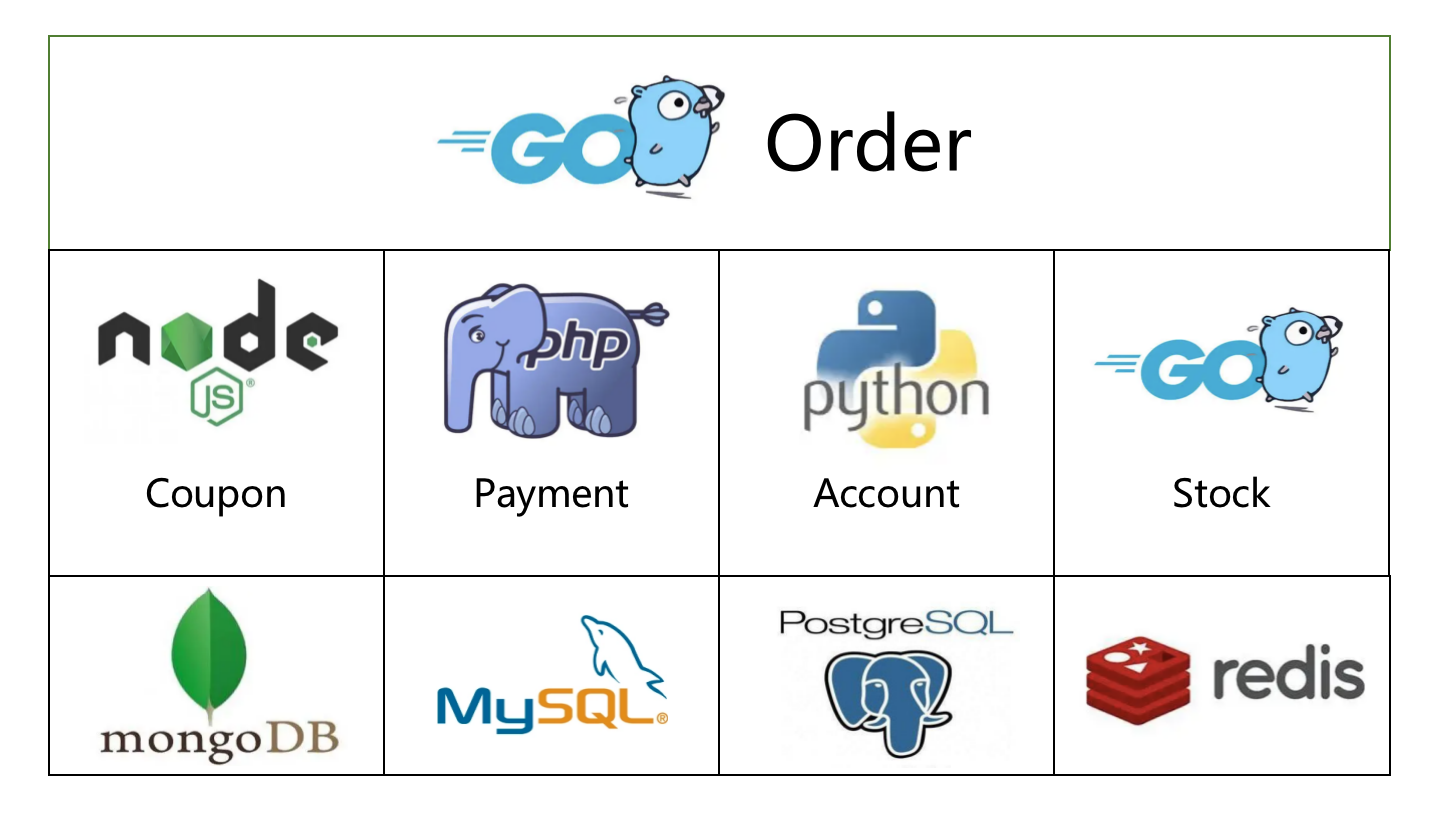
Who's using DTM (partial)
Cook Book
Quick start
run dtm
git clone https://github.com/dtm-labs/dtm && cd dtm
go run main.go
Start an example
Suppose we want to perform an inter-bank transfer. The operations of transfer out (TransOut) and transfer in (TransIn) are coded in separate micro-services.
Here is an example to illustrate a solution of dtm to this problem:
git clone https://github.com/dtm-labs/dtmcli-go-sample && cd dtmcli-go-sample
go run main.go
Code
Use
  // business micro-service address
  const qsBusi = "http://localhost:8081/api/busi_saga"
  // The address where DtmServer serves DTM, which is a url
  DtmServer := "http://localhost:36789/api/dtmsvr"
  req := &gin.H{"amount": 30} // micro-service payload
	// DtmServer is the address of DTM micro-service
	saga := dtmcli.NewSaga(DtmServer, dtmcli.MustGenGid(DtmServer)).
		// add a TransOut subtraction,forward operation with url: qsBusi+"/TransOut", reverse compensation operation with url: qsBusi+"/TransOutCom"
		Add(qsBusi+"/TransOut", qsBusi+"/TransOutCom", req).
		// add a TransIn subtraction, forward operation with url: qsBusi+"/TransIn", reverse compensation operation with url: qsBusi+"/TransInCom"
		Add(qsBusi+"/TransIn", qsBusi+"/TransInCom", req)
	// submit the created saga transaction,dtm ensures all subtractions either complete or get revoked
	err := saga.Submit()
When the above code runs, we can see in the console that services TransOut, TransIn has been called.
Timing diagram
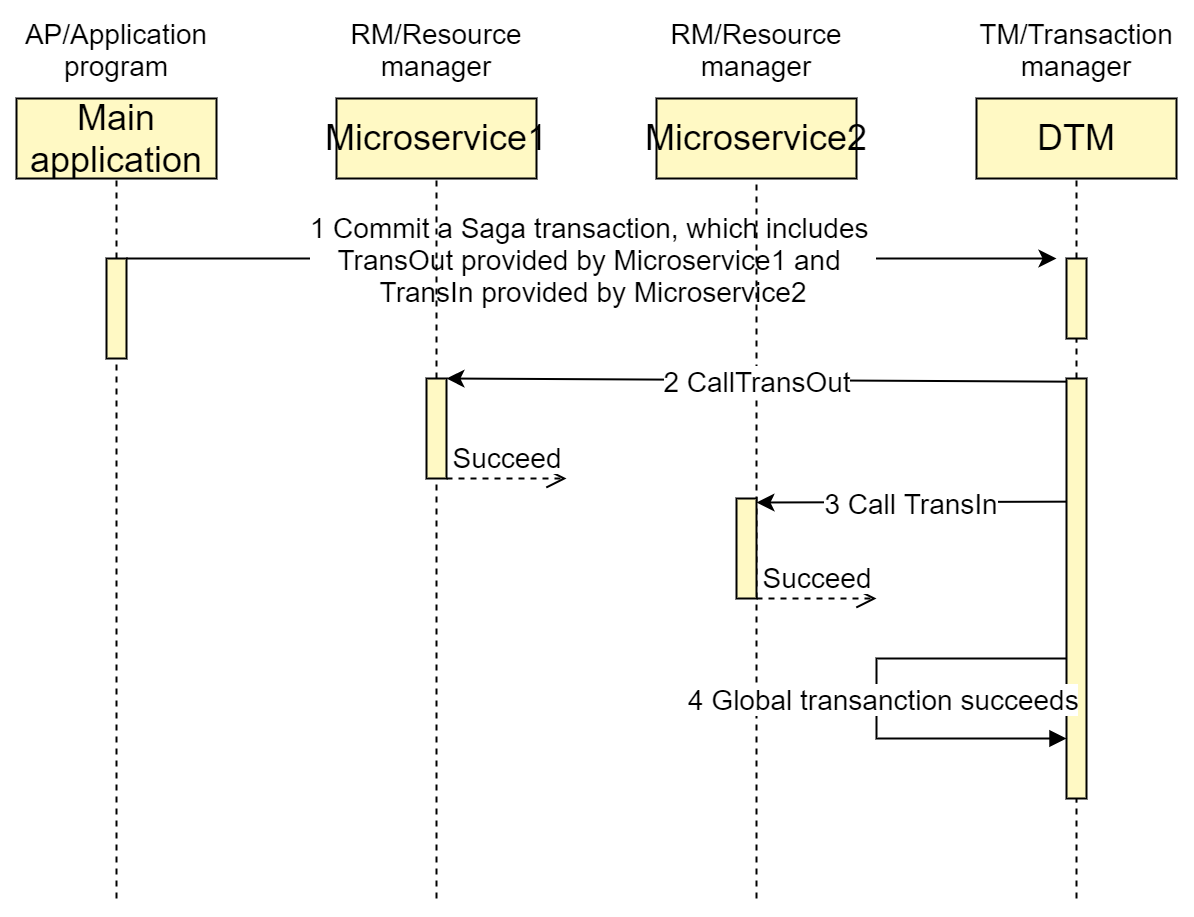
A timing diagram for a successfully completed SAGA transaction would be as follows:
Rollback upon failure
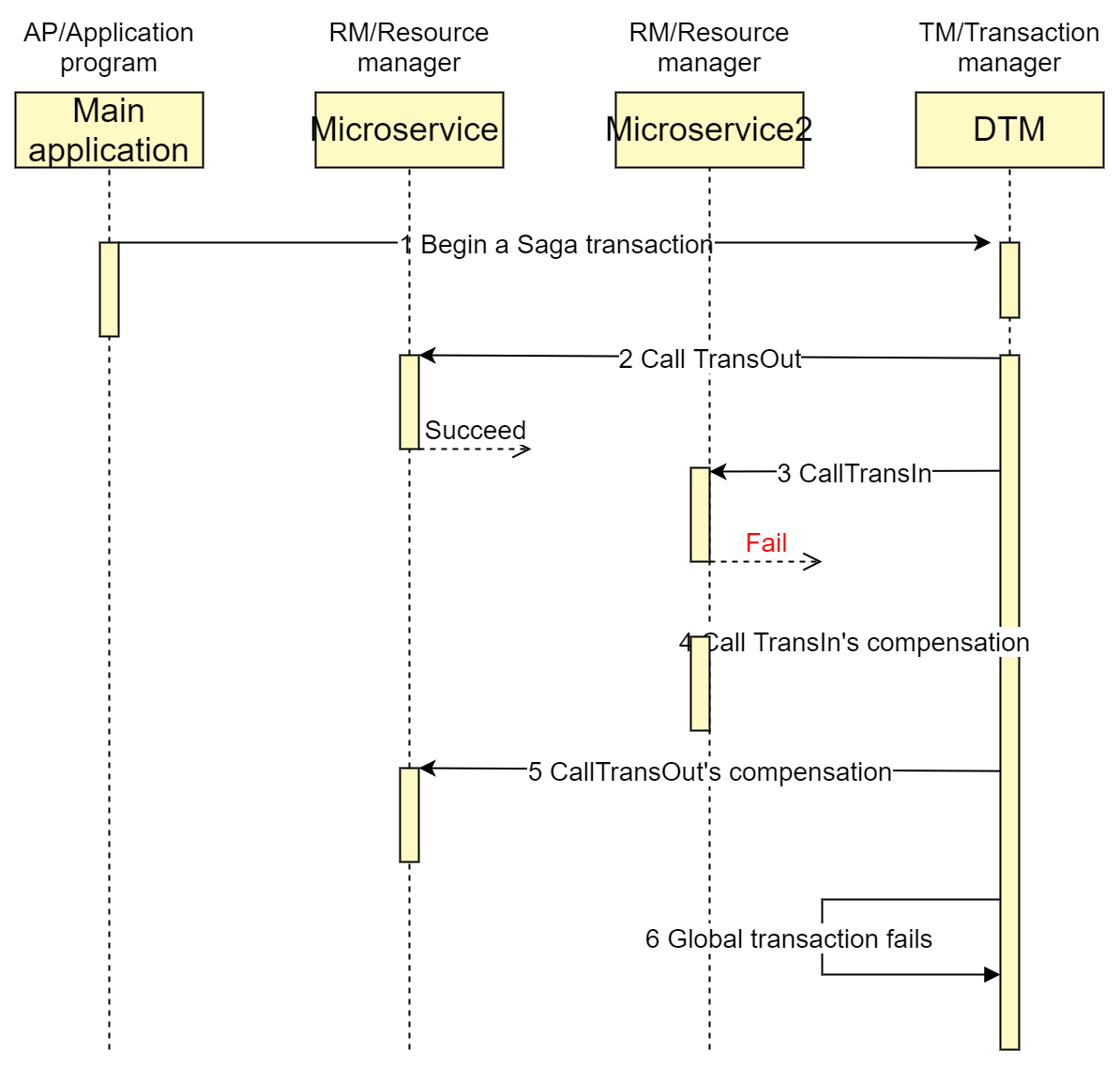
If any forward operation fails, DTM invokes the corresponding compensating operation of each sub-transaction to roll back, after which the transaction is successfully rolled back.
Let's purposely fail the forward operation of the second sub-transaction and watch what happens
app.POST(qsBusiAPI+"/TransIn", func(c *gin.Context) {
  log.Printf("TransIn")
  // c.JSON(200, "")
  c.JSON(409, "") // Status 409 for Failure. Won't be retried
})
The timing diagram for the intended failure is as follows:
More examples
The above example mainly demonstrates the flow of a distributed transaction. More on this, including practical examples of how to interface with an actual database, how to do compensation, how to do rollback, etc. please refer to dtm-examples for more examples.
Slack
You can join the DTM slack channel here.
Give a star! ⭐
If you think this project is interesting, or helpful to you, please give a star!